
Contents
- 1 Chapter 1: Understanding the Basics – What is an Industrial RO Plant?
- 2 Chapter 2: Why Water Quality Matters (More Than You Think)
- 3 Chapter 3: Sizing It Right – Don’t Overbuy (or Underestimate)
- 4 Chapter 4: Pretreatment – The Unsung Hero
- 5 Chapter 5: Membrane Matters – Not All Are Created Equal
- 6 Chapter 6: Automation vs. Manual – What’s Right for You?
- 7 Chapter 7: Energy Efficiency & Environmental Impact
- 8 Chapter 8: Cost Breakdown – Upfront vs. Long-Term
- 9 Chapter 9: Certifications, Compliance & Safety
- 10 Chapter 10: Choosing the Right Vendor – More Than Just a Supplier
- 11 Final Checklist: Your RO Plant Decision Matrix
- 12 Conclusion: Make a Choice That Lasts
Water. It’s the lifeblood of industries—from manufacturing and pharmaceuticals to food processing and power generation. But not just any water will do. When precision, purity, and performance are required, businesses turn to Industrial RO Plants for water treatment. If you’re in the market to choose the right industrial RO plant for your water treatment, you know it’s a decision that carries weight—not just financially, but operationally and environmentally.
In this guide, we’ll walk you through every consideration you need to make before investing in an Industrial RO Plant, from water quality analysis to capacity planning, cost implications, and long-term maintenance. No jargon. No fluff. Just practical insights, told in a language that makes sense—because that’s what real decision-making needs.
Chapter 1: Understanding the Basics – What is an Industrial RO Plant?
Let’s start with the basics.
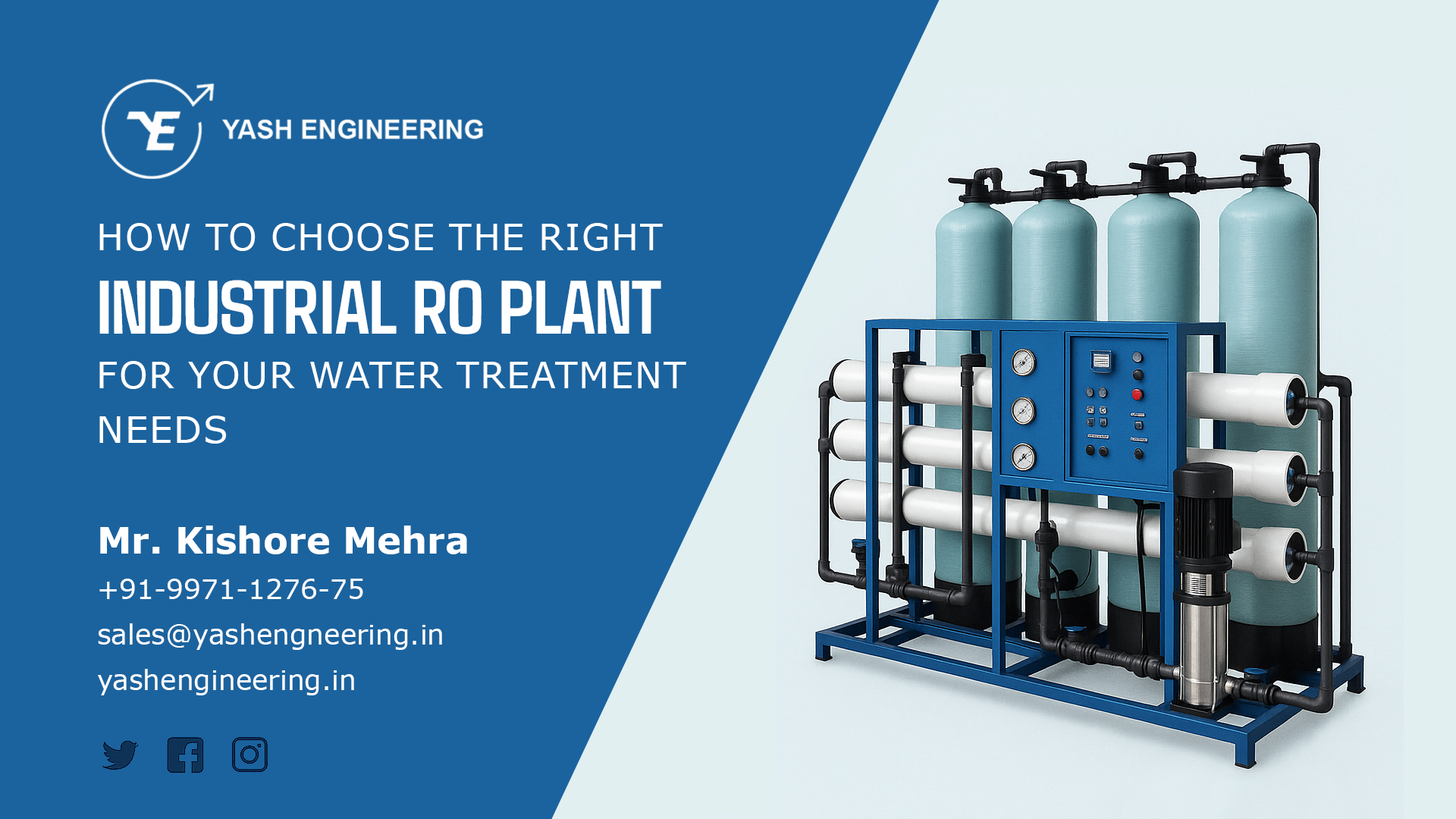
RO stands for Reverse Osmosis. In simple terms, it’s a filtration method that removes impurities from water by forcing it through a semipermeable membrane. Think of it like a super-fine sieve that lets only clean water through, leaving behind salts, bacteria, and other contaminants.
An Industrial RO Plant takes this principle and scales it up. These systems are designed for high-volume operations, capable of producing thousands of liters of purified water per hour. They are used in:
-
Beverage and food processing
-
Pharmaceutical manufacturing
-
Textile and dyeing industries
-
Boiler feedwater systems
-
Electronics and semiconductor production
So when we talk about an industrial RO plant for your water treatment, we’re talking about a solution designed to meet stringent water quality standards in high-demand environments.
Chapter 2: Why Water Quality Matters (More Than You Think)
Before jumping into the specs of an RO plant, step one is always a water analysis. Why? Because the quality of your input water determines what kind of RO system you’ll need.
Here are some common water sources and their challenges:
-
Groundwater: Often high in hardness, iron, and dissolved solids
-
Surface water: Prone to organic contamination and seasonal changes
-
Municipal water: Treated but may contain residual chlorine or chloramine
-
Wastewater/effluent recycling: Requires advanced pre-treatment
A professional water analysis will look at parameters like:
-
TDS (Total Dissolved Solids)
-
pH levels
-
Hardness (Calcium, Magnesium)
-
Nitrate, Chloride, Sulfate concentrations
-
Microbiological contamination
Why does this matter?
Because the type of Industrial RO Plant you need depends heavily on what it’s removing. A high TDS groundwater source may need a multi-stage RO system. Surface water may need additional pre-treatment like ultrafiltration or UV.
Chapter 3: Sizing It Right – Don’t Overbuy (or Underestimate)
Another crucial step in choosing the right industrial RO plant for your water treatment is determining the correct capacity.
Overestimating leads to wasted investment and operating inefficiencies. Underestimating means frequent breakdowns and supply shortages. Neither is ideal.
Ask yourself:
-
How much treated water do you need daily?
-
Is the demand consistent or fluctuating?
-
Do you need storage or real-time supply?
-
Are there future expansion plans?
A typical industrial RO plant ranges from 1,000 LPH (liters per hour) to 1,00,000+ LPH. But capacity planning isn’t just about raw numbers. It’s about understanding your process, consumption patterns, and peak loads.
Pro tip: Always include a 10–20% buffer in capacity to accommodate future scalability.
Chapter 4: Pretreatment – The Unsung Hero
Here’s a mistake many first-time buyers make: They think the RO system alone is the hero of water purification. In reality, the real MVP is pretreatment.
Pretreatment ensures that the water going into your Industrial RO Plant is already free from large particulates, organics, and chemicals that could damage the RO membranes.
Depending on your water source, pretreatment can include:
-
Media Filters (sand, carbon, gravel)
-
Softening Units
-
Anti-scalants and dosing systems
-
Micron Cartridge Filters
-
UV or Ozonation units
Why is this so important?
Because poorly pretreated water will foul the RO membranes faster, reducing the system’s efficiency, increasing maintenance costs, and shortening equipment life.
When selecting an industrial RO plant for your water treatment, make sure to invest in a comprehensive pretreatment setup tailored to your feed water type.
Chapter 5: Membrane Matters – Not All Are Created Equal
At the heart of every Industrial RO Plant is the membrane—the component responsible for actual filtration. Membrane quality, configuration, and material make a massive difference in performance and longevity.
Key types include:
-
Polyamide Thin-Film Composite (TFC): The most commonly used for industrial RO
-
Cellulose Acetate: Less common, used in specific conditions
Other factors to consider:
-
Membrane rejection rate: How effectively it removes salts/contaminants
-
Flow rate and recovery ratio: Balance between water output and waste
-
Cleaning protocols: Some membranes allow chemical cleaning; others don’t
The bottom line: Choose membranes that match your water profile and operational expectations. Ask your supplier for membrane performance sheets and warranty coverage.
Chapter 6: Automation vs. Manual – What’s Right for You?
Modern Industrial RO Plants offer automation features that can be a game-changer in terms of efficiency, labor savings, and consistency.
Options include:
-
Automatic backwash and flushing
-
Flow and pressure monitoring
-
Real-time TDS meters and alarms
-
PLC-based control panels with HMI touchscreens
-
Remote monitoring via IoT
However, these systems come at a cost—and complexity.
For smaller operations or budget-conscious setups, semi-automatic or manual systems can still deliver excellent results with proper training and SOPs.
So how do you decide?
-
High-volume, critical process? Go for automation.
-
Budget-limited, non-critical use? Manual can work—with care.
Either way, ensure that the system is user-friendly and well-documented.
Chapter 7: Energy Efficiency & Environmental Impact
An often-overlooked aspect of choosing the right industrial RO plant for your water treatment is its energy and environmental footprint.
RO systems consume electricity primarily through high-pressure pumps. Look for:
-
Energy-efficient motors
-
Variable Frequency Drives (VFDs)
-
Energy recovery devices (for large-scale systems)
Additionally, consider wastewater management. RO plants reject 30–60% of input water as brine. That’s a lot of water if you’re running a large unit.
Solutions include:
-
Zero Liquid Discharge (ZLD) systems
-
Reject water reuse in non-critical operations
-
Brine minimization with secondary RO stages
Sustainability isn’t just a buzzword. It affects your long-term operational costs and compliance with environmental regulations.
Chapter 8: Cost Breakdown – Upfront vs. Long-Term
Cost is always a deciding factor. But the cheapest option upfront may not be the most affordable in the long run.
Here’s how to break it down:
Upfront Costs:
-
RO Unit
-
Pretreatment system
-
Installation and commissioning
-
Civil work and plumbing
Ongoing Costs:
-
Electricity
-
Membrane replacement (every 2–3 years)
-
Filter media and cartridges
-
Chemical dosing
-
Skilled labor
-
Service contracts
Hidden Costs:
-
Downtime
-
Water wastage
-
Compliance penalties
-
Emergency maintenance
Total Cost of Ownership (TCO) is what you really need to calculate. A slightly higher-capex plant with better efficiency and lower downtime may save you lakhs over its lifespan.
Chapter 9: Certifications, Compliance & Safety
Your RO plant should comply with local and international safety and quality standards, especially if your treated water is used in food, pharma, or electronics.
Look for:
-
ISO certification (9001, 14001, etc.)
-
CE marking
-
FDA or WHO compliance (for relevant industries)
-
Local pollution control board approval
Also, insist on a user manual, training, and safety guidelines. A plant is only as safe as its operators are trained.
Chapter 10: Choosing the Right Vendor – More Than Just a Supplier
Finally, no matter how perfect a system looks on paper, its performance is only as good as the team behind it.
When selecting a vendor for your Industrial RO Plant, evaluate:
-
Industry experience
-
Customer references
-
Service infrastructure
-
Customization capability
-
Spare parts availability
-
Warranty and AMC terms
Have a detailed discussion. Ask for a site visit. Understand their after-sales service terms. A good vendor is a long-term partner, not just a one-time seller.
Final Checklist: Your RO Plant Decision Matrix
To summarize, here’s a checklist to help choose the right industrial RO plant for your water treatment:
✅ Get a comprehensive water analysis
✅ Define your water quality and quantity needs
✅ Choose the correct plant capacity
✅ Don’t skip on proper pretreatment
✅ Select the right membrane and configuration
✅ Decide on automation level based on scale
✅ Factor in energy use and wastewater management
✅ Understand the full cost of ownership
✅ Verify certifications and compliance
✅ Choose a reliable, experienced vendor
Conclusion: Make a Choice That Lasts
Investing in an industrial RO plant for your water treatment is not just a technical decision—it’s a strategic one. The right choice can reduce your costs, improve product quality, minimize downtime, and help you meet sustainability goals.
But to get there, you need to go beyond brochures and buzzwords. Ask questions. Demand data. Insist on transparency. Work with partners who care about your water as much as you do.
So, whether you’re starting a new factory, upgrading an old system, or simply planning ahead—choose the right industrial RO plant for your water treatment by putting knowledge, clarity, and care first.
Because in business, like in water, purity always pays off.